












Ayos kaayo videos nimo boss. More uploads, more power!

eKo
Informative kaayo sir! Thank you sir!
Sa uban ani naa nani bayad, premium course nani..

Rodmark
Salamat kaayu sir ani imong free tutorial. Godbless you more Sir...

Inday
Thank you sa free course boss

Niza Meliston
Salamat sir. unta dili ka mag sawa mag upload ug mga tutorials unsaon pag work aning SEO. dako kaayung tabang ❤️

Crislao
sulit na tutorial boss. simple and direct to the point.

JCD Gaming



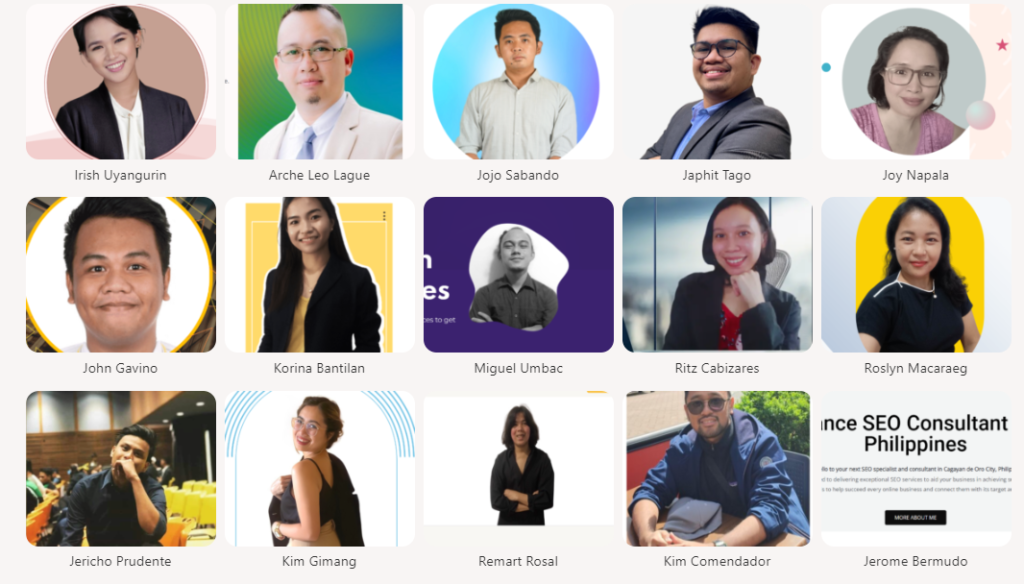
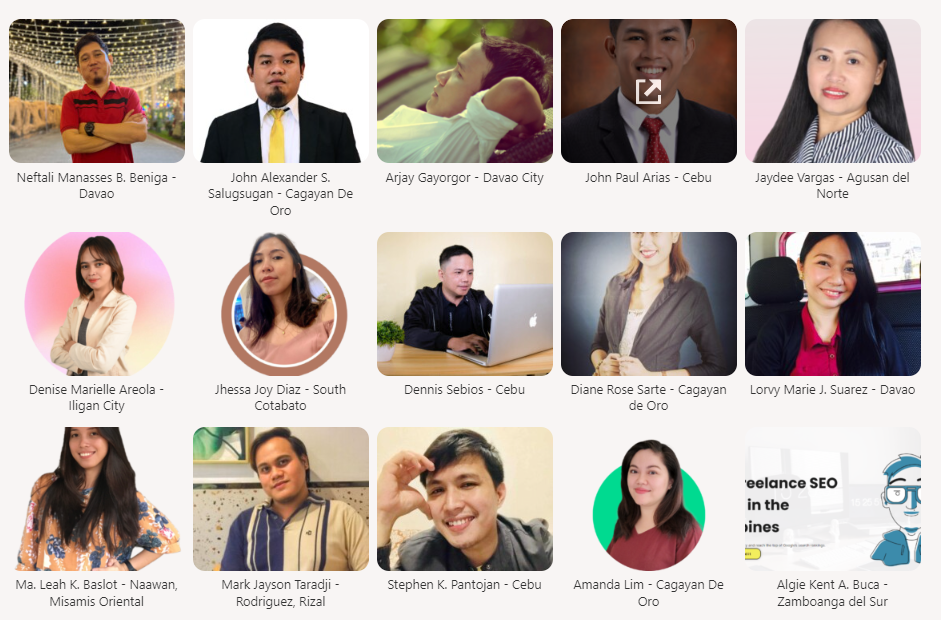

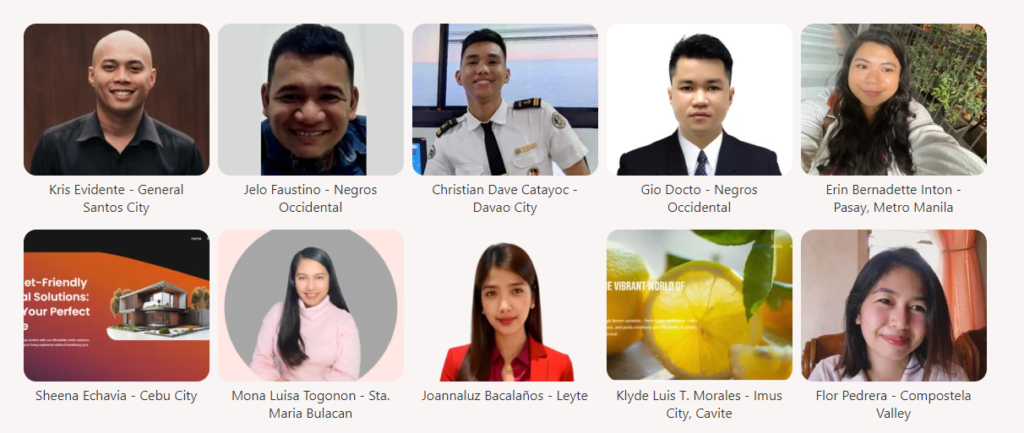
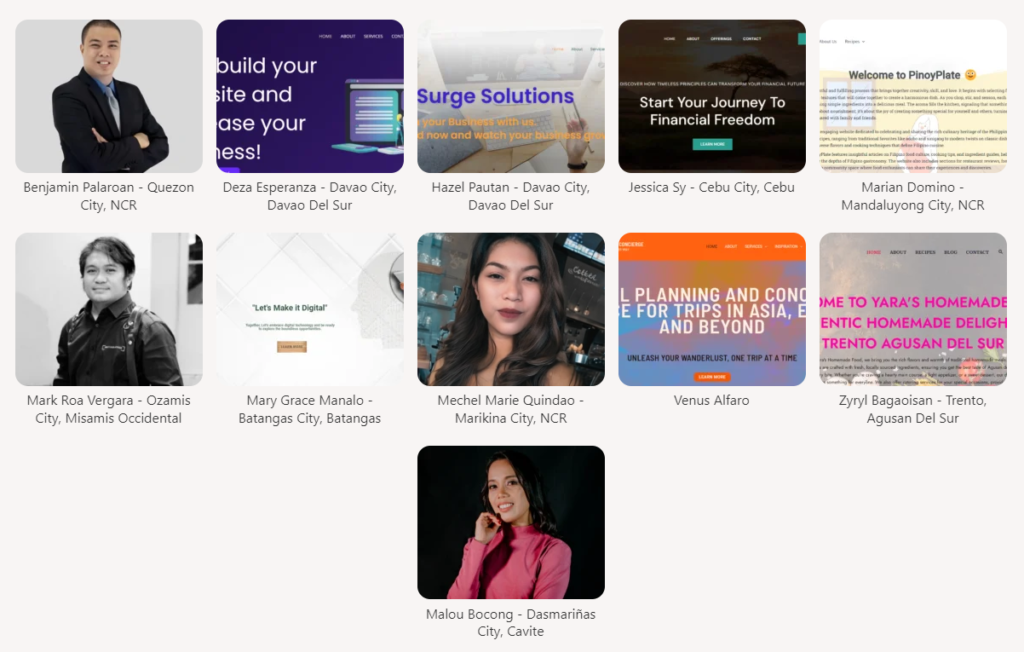
Homepage
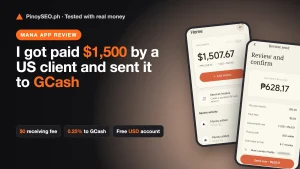
October 20, 2026Disclosure: This is a sponsored review in partnership with Mana. I tested the app with my own money and a real client payment, and every number below comes from my own screenshots. Fees and rates may change, so always check the app before you send.
If you’re a Filipino freelancer, VA, or SEO specialist with foreign clients, you know the pain: every payday, part of your income disappears to receiving fees and bad conversion rates.
I run an SEO agency (MalachiSoft) and train Filipino SEO specialists here at PinoySEO, so I get paid in US dollars a lot. In October 2026, I tested Mana, a free US dollar account built for Filipinos earning abroad and from online jobs. I had one of my agency’s US clients pay me $1,500 through it, topped up from Maya, sent money to GCash, and activated the digital Visa card.
Here’s exactly what happened, with screenshots and real fees.
Quick Verdict: My Mana Test Results
What I tested
Result
Fee
Opening the USD account
US account and routing number in the app
Free
Receiving $1,500 by ACH from a US client
Arrived the same day
$0
Top-up from Maya (₱500)
$7.67 at ₱63.09, within minutes
$0.25
Send $10 to GCash
₱628.17 arrived in about 1 minute
0.25% ($0.03)
Digital Visa card in USD
Approved and activated
Free (physical card: $10)
What Is Mana?
Mana is a financial app by KINNECTFI, Inc. that gives Filipinos a free, real US dollar account. You get US account details (account and routing number), so US clients can pay you by ACH, the same way they pay any American vendor. Your account details are with SSB Bank in Pittsburgh, PA, and the full address is shown in the app.
Your money stays in USD until you decide to convert it. When you need pesos, you send it to GCash. Mana is available on both the App Store and Google Play.
My Mana home screen after the client payment arrived
My Test, Step by Step
Step 1: A US client paid me $1,500 by ACH
I sent one of my agency’s US clients my Mana account details (bank name, routing number, and account number) and asked them to pay by ACH. The $1,500 arrived the same day, and Mana charged $0 to receive it.
Mana’s confirmation email: $1,500.00 deposited on Oct 16, 2026
Tip: if your client asks for the bank address, tell them the account is with SSB Bank in Pittsburgh, PA. You’ll find the full address and routing number in the app.
Step 2: I topped up from Maya (pesos to USD)
You can also add money from any Philippine bank or e-wallet through InstaPay. I sent ₱500 from Maya and got $7.67 at ₱63.09 per dollar, with a $0.25 fee. It reached my USD wallet within minutes.
The top-up review screen shows the rate and fee before you pay
Note that the $0.25 fee is about 3% on a small ₱500 top-up, so it makes more sense for bigger amounts.
Step 3: I sent $10 to GCash for a 0.25% fee
This is the part I cared about most. Before sending, Mana shows you a guaranteed rate and the exact fee. I sent $10, paid a $0.03 fee (0.25%), and the recipient amount was ₱628.17. Mana confirmed that 0.25% is its standard GCash pricing.
Review screen: $10.00, total fees $0.03, guaranteed rate ₱63.01
The transfer email lists the exact rate and fee
Step 4: The pesos landed in GCash in about a minute
The app estimated 5 to 7 minutes. The ₱628.17 actually arrived in my GCash about a minute after I tapped send.
My GCash receipt: +₱628.17 (reference details blurred)
Step 5: I activated the digital Visa card in USD
Mana also gives you a digital Visa card that spends straight from your USD balance. That’s useful for paying for SEO tools, software subscriptions, and ads in dollars without converting to pesos first. The digital card is free. A physical card costs $10, which I skipped for now.
The digital Visa card (card number and expiry hidden)
Mana Fees at a Glance
Account: free
Receiving ACH payments: $0 (my $1,500 test)
Sending to GCash: 0.25% of the amount
Top-up from a PH bank or e-wallet: $0.25 on my ₱500 Maya top-up
Digital Visa card: free; physical card $10
These are the fees I paid in October 2026. Always check the review screen in the app before you confirm.
Pros and Cons
What I liked
A free, real USD account that US clients can pay by ACH
$0 receiving fee on my $1,500 payment, which arrived the same day
You keep your money in USD and choose when to convert
Only 0.25% to send to GCash, with the rate shown before you send
Fast: my GCash transfer arrived in about a minute
A digital Visa card in USD for tools and subscriptions
What to keep in mind
The flat $0.25 top-up fee is a bigger share of small top-ups
It’s a newer app, so there aren’t many public reviews yet
Everything happens in the mobile app; on a desktop computer, the sign-up link opens the App Store page
The physical card costs $10
Who Is Mana For?
Mana makes the most sense if you’re a Filipino freelancer, VA, SEO specialist, or agency owner whose clients are in the US and can pay by ACH. It’s also useful if you want to hold part of your earnings in dollars instead of converting everything to pesos right away.
How to Sign Up
Open pinoyseo.ph/mana on your phone. It takes you to the App Store or Google Play.
Download the app and verify your identity.
Find your US account details in the app and send them to your client.
Get your free Mana USD account →
Frequently Asked Questions
Is Mana free?
Yes. Opening the USD account is free, and I paid $0 to receive a $1,500 ACH payment. Sending to GCash costs 0.25%.
How long does a transfer from Mana to GCash take?
The app estimated 5 to 7 minutes. My transfer arrived in about 1 minute.
Can I add money to Mana from Maya or a Philippine bank?
Yes. I topped up ₱500 from Maya through InstaPay and received $7.67 at ₱63.09, with a $0.25 fee.
What bank details do I give my US client?
Your account name, routing number, and account number, all shown in the Mana app. The account is with SSB Bank in Pittsburgh, PA. Ask your client to send an ACH transfer.
Is Mana available on Android?
Yes. Mana is on both Google Play and the App Store.
Want to Land US Clients in the First Place?
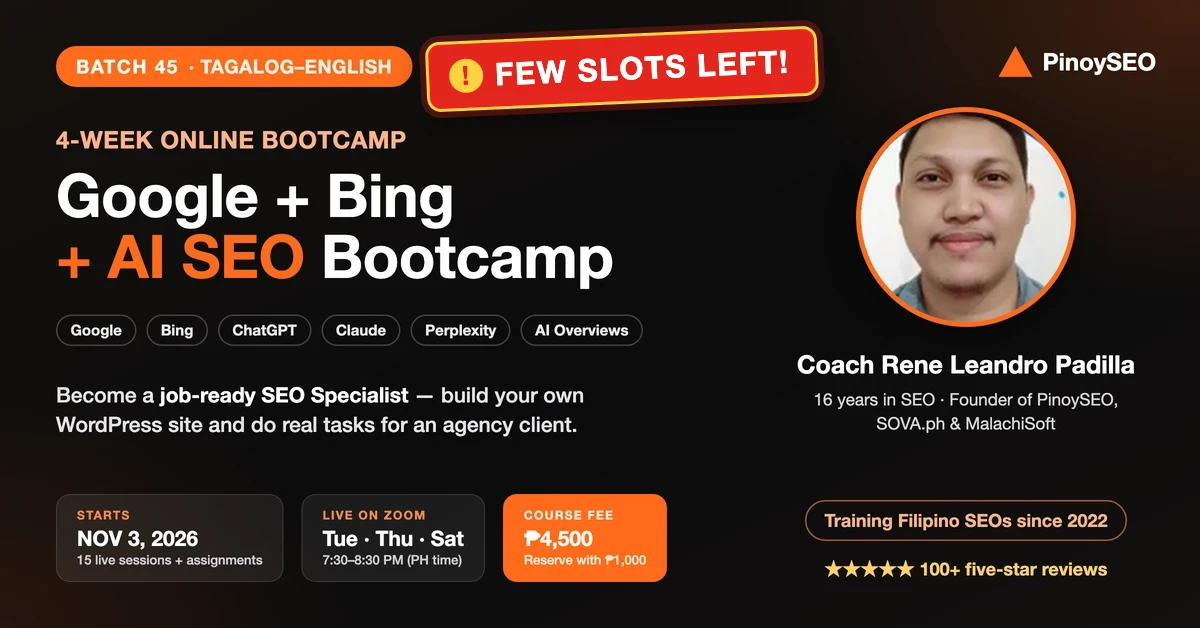
A USD account helps once the clients are paying you. If you want to learn SEO and start getting those clients, check out our Batch 45 Google, Bing & AI SEO Bootcamp, starting November 3, 2026.
Laban lang, mga ka-freelancer! 💪
Sponsored partnership with Mana. I tested the app with my own money and client payments. Results and fees may vary. [...]
Read more...

October 9, 2026Another student win came through Messenger this week, from Adrielle Rivera, one of our Batch 43 graduates:
“Hi Coach Leandro. Hired na po ako ehehe. Waiting na lang sa contract 🙂 Thank you po sa pag turo samin.”
(Translation: “I’m hired now. Just waiting for the contract. Thank you for teaching us.”)
— Adrielle Rivera, PinoySEO Bootcamp Batch 43
Adrielle accepted an offer as a Digital Marketing Specialist (SEO) on Upwork on October 7, 2026. And when I asked him what made the difference, his answer is something every freelancer should hear.
Adrielle’s messages, with the client’s offer (client name and rate blurred for privacy).
The offer
The client’s message was short and clear: they wanted Adrielle to start that same week, bringing him on board with a project and an hourly contract. The offer on Upwork was accepted the same day:
Role: Digital Marketing Specialist — SEO
Platform: Upwork
Job category: Marketing Strategy
Offer accepted: October 7, 2026
We blurred the client’s name and the rate for privacy — but the important part is visible: a real client, a real contract, and a PinoySEO graduate getting paid to do SEO.
What made the difference: he optimized his own Upwork profile
Here’s what Adrielle told me:
“Nag update lang po ako ng job title and job description sa Upwork kaya na consider po ako coach. Hehe laking tulong po talaga ng optimization.”
(Translation: “I just updated my job title and job description on Upwork, and that’s why I got considered, coach. Optimization really helped a lot.”)
Think about that. Adrielle used the same skills we teach for websites — keyword research, writing for search intent, clear titles and descriptions — on his own Upwork profile. Upwork is a search engine too. Clients search for terms like “SEO specialist,” and the profiles that match what clients are looking for get seen first.
That’s SEO thinking applied to your own career.
The full Adrielle arc
PinoySEO Bootcamp, Batch 43 — 4 weeks of live training on keyword research, website audits, on-page and technical SEO, local SEO, and GEO (AI search optimization).
Built his own portfolio site — adriellerivera.pinoyseo.net, presenting his local SEO, on-page, technical SEO, and link-building services.
Optimized his Upwork profile — updated his job title and job description using what he learned.
Got considered, then hired — offer accepted on October 7, 2026, as a Digital Marketing Specialist (SEO).
Check out Adrielle’s portfolio site
Every PinoySEO Bootcamp student builds an SEO portfolio site, and Adrielle’s shows exactly how he positions himself: an SEO specialist for US and Australian businesses, focused on local SEO, on-page optimization, and link building.
Adrielle’s portfolio site: adriellerivera.pinoyseo.net
Visit Adrielle’s site → adriellerivera.pinoyseo.net
Three lessons from Adrielle’s story
1. Your freelance profile is a search result — optimize it
Upwork, OnlineJobs.ph, and LinkedIn all work like search engines. Clients type in what they need. If your title and description don’t match those searches, you’re invisible — no matter how good you are. Use the right keywords, say clearly who you help and what results you deliver.
2. Small changes can unlock big results
Adrielle didn’t need a new course or a new certificate. He updated two fields — his job title and job description. Sometimes the fastest win is applying what you already know to your own assets.
3. Practice SEO on yourself first
Your portfolio site, your Upwork profile, your LinkedIn — these are your first “clients.” If you can make yourself easy to find and easy to hire, you can do it for a business too. And that’s exactly the proof employers and clients want to see.
What this means for anyone considering PinoySEO training
Start free. Watch the free courses on our courses page to see if SEO is for you.
Join the 4-week Bootcamp. Live training, real practice, and a batch to learn with.
Build your portfolio site. Like Adrielle’s, it becomes your online CV.
Optimize your profiles. Apply SEO to your Upwork, OnlineJobs, and LinkedIn — then start applying.
Batch 45 is now open for reservations. Classes start Tuesday, November 3, 2026 — 15 live Zoom sessions plus assignments, Tue/Thu/Sat at 7:30–8:30 PM. Reserve your slot for ₱1,000 →
Already a PinoySEO graduate with your own win to share? Message us at pinoyseo2022@gmail.com. We love telling these stories.
To Adrielle — congrats, bro
Adrielle, this one is all you. You took what you learned, applied it to your own profile, and turned it into a real contract. That’s exactly the mindset of a true SEO.
Getting hired is the starting line, not the finish line. Keep learning, deliver results for your client, and keep helping your batchmates. Proud of you. Laban lang!
— Coach Leandro
Related posts
Student Success: Kenneth Relox — Bootcamp to First SEO Job
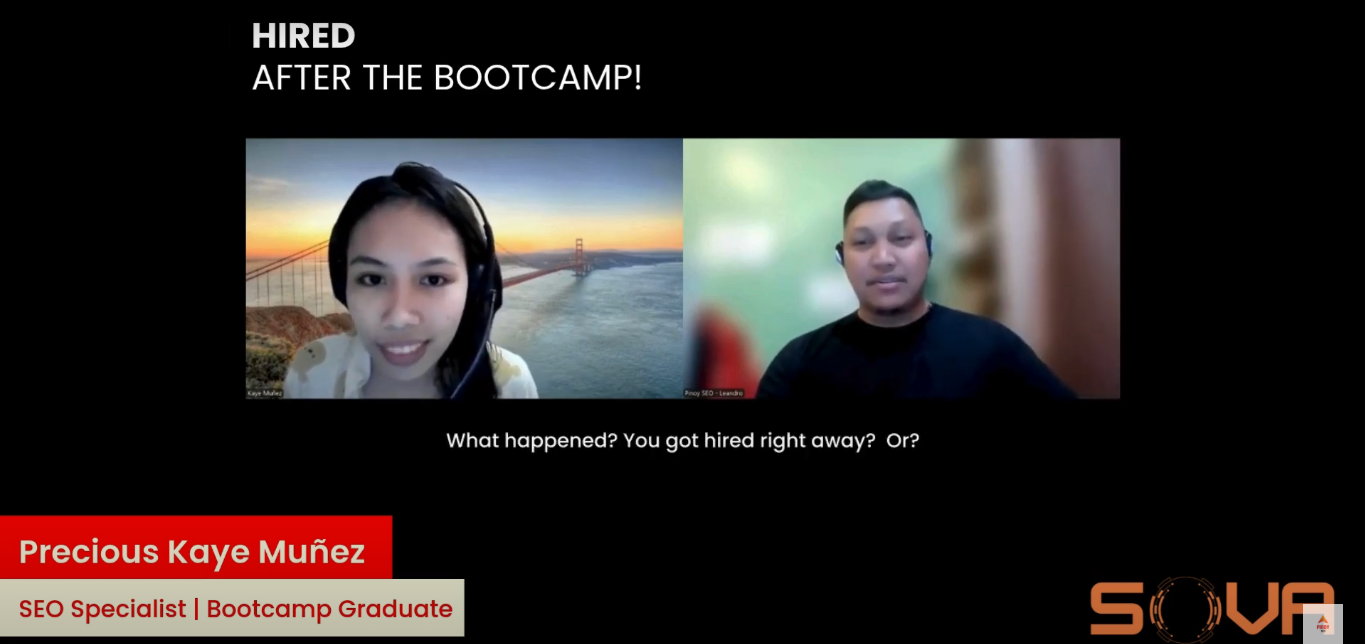
Student Success: Clent Corpuz — Hired During Training, Now Full-Time Across 4 Brands
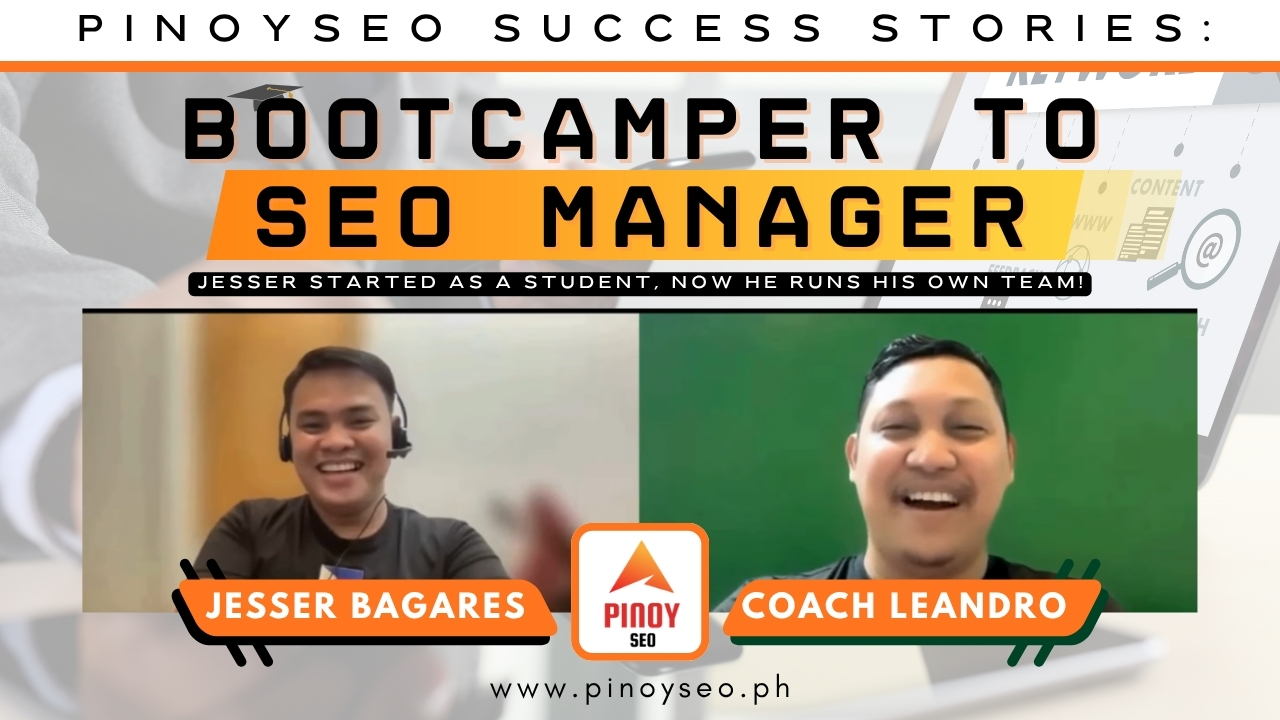
Student Success: Jesrell Belmes — Bootcamp to SEO Lead [...]
Read more...

October 2, 2026Some messages make the whole week. This one came into our Slack at 8:48 in the morning:
“Good morning coach. I made it po, landed my first job as SEO specialist.”
— Kenneth Relox, PinoySEO Bootcamp Batch 41
Kenneth is one of our Batch 41 graduates. He went through the 4-week PinoySEO Bootcamp, then straight into a 60-day internship at Malachisoft, our agency, where he worked on a real client. Now he has his first full-time job offer as an SEO Specialist.
Ikaw na, Kenneth.
Kenneth’s message in our Slack, with the offer email (employer name blurred for privacy).
The offer that landed in Kenneth’s inbox
Kenneth shared the email that came with the offer. We are keeping the company name private, but the important part is right there in the first lines:
“Hey Kenneth, I’d like to offer you the SEO role with . Your audit, the call, and your follow-up answers all pointed the same direction, and I’m excited to get started.”
Read that again, especially if you are still a student. The employer did not say “your certificate” or “your years of experience.” They named three things:
The audit — Kenneth showed his work before he was hired. He did not just say he knows SEO. He proved it on their site.
The call — he could explain his findings out loud, clearly, to a decision-maker.
The follow-up answers — after the call, he followed through. Same quality, same direction.
That is exactly what we drill in the Bootcamp and the internship. Employers can tell the difference between someone who memorized SEO terms and someone who has actually done the work.
The full Kenneth arc
PinoySEO Bootcamp, Batch 41 (4 weeks) — live training on keyword research, technical SEO, on-page, content strategy, website audits, and GEO (Generative Engine Optimization) for AI search.
Malachisoft internship (60 days) — Kenneth joined our agency team and worked on a real agency client. Real deadlines, real reporting, real feedback. Not a practice site.
Built his own portfolio site — kennethrelox.pinoyseo.net, where he presents his services in WordPress SEO, technical SEO, local SEO, and GEO.
Applied, audited, interviewed — he sent an audit, did the call, and answered follow-up questions.
Hired — first full-time role as an SEO Specialist.
Check out Kenneth’s portfolio site
Every PinoySEO Bootcamp student builds their own SEO portfolio website — and Kenneth’s is a good example of what a job-ready SEO’s online presence looks like. It shows who he is, the SEO services he offers, and the work he has done, all on a site he optimized himself.
Kenneth’s portfolio site: kennethrelox.pinoyseo.net
On his site you will find:
His services — WordPress SEO, keyword research and content strategy, technical SEO, local SEO, and GEO for AI-powered search.
His work — portfolio projects including ADM Auto Services and Flower Bar Cebu.
How to reach him — if you are a business owner looking for an SEO specialist, you can contact Kenneth directly through his site.
Visit Kenneth’s site → kennethrelox.pinoyseo.net
Why the internship after the Bootcamp matters
The Bootcamp teaches you the skills. The internship is where you prove you can use them when it counts.
Inside Malachisoft, interns work on an actual agency client. That changes everything. You learn how a client thinks, how to prioritize fixes when you cannot do everything at once, how to report progress, and how to explain SEO to someone who does not care about the jargon — they only care about results.
So when Kenneth sat down to audit a prospective employer’s website, it was not his first time. When he got on the call, he had already explained SEO findings to a real client. And when the follow-up questions came, he already knew what good work looks like, because he had been doing it for 60 days.
That is the gap most new SEOs struggle with: “no experience, no job; no job, no experience.” The internship closes that gap.
Three lessons from Kenneth’s story
1. Show, don’t tell — lead with an audit
Kenneth’s audit was the first thing his new employer mentioned. If you are applying for SEO roles, do not just send a CV. Audit their website (or a site in their industry) and show them what you would fix first and why. It instantly separates you from everyone else in the pile.
2. Communication is half the job
The call and the follow-up answers were the other two reasons Kenneth got hired. You can be very good at SEO, but if you cannot explain your findings clearly, clients and employers will not trust you with their website. Practice explaining your audits out loud — to your batchmates, to your family, to anyone who will listen.
3. Real client work beats more theory
Watching more tutorials will only take you so far. What made Kenneth job-ready was 60 days of hands-on work on a real client. If you finish the Bootcamp, find a way to work on real sites — an internship, a small business owner you know, or your own projects. Experience is what you will talk about in your interviews.
What this means for anyone considering PinoySEO training
Kenneth’s path is a simple one you can follow:
Start free. Watch the free courses on our courses page and our YouTube channel to see if SEO is for you.
Join the 4-week Bootcamp. Structured, live, with a batch to learn with, in Bisaya, Tagalog, Filipino, or English.
Do real work. Qualified graduates can continue to the Malachisoft internship and work on a real agency client.
Build your portfolio site. Like Kenneth’s, it becomes your online CV.
Apply with an audit. Show your work. Then do great on the call.
If you are ready to start your SEO career with training built around real client work, not textbook theory, the PinoySEO Bootcamp is where graduates like Kenneth got their foundation.
Batch 45 will be announced soon. Batch 44 is already underway, and the schedule for the next batch is coming. Keep an eye on pinoyseo.ph so you don’t miss the announcement.
Already a PinoySEO graduate with your own win to share? Message us at pinoyseo2022@gmail.com. We love telling these stories.
To Kenneth — congrats, bro
Kenneth, this one is all you. You did the work in the Bootcamp, you showed up for 60 days in the internship, and you nailed the audit, the call, and the follow-ups. The offer email says it plainly: everything pointed the same direction.
Remember, getting hired is the starting line, not the finish line. Keep learning, keep delivering results, and keep helping the next batch the way you were helped.
Proud of you. Padayon!
— Coach Leandro
Related posts
Student Success: Clent Corpuz — Hired During Training, Now Full-Time Across 4 Brands
Student Success: Jesrell Belmes — Bootcamp to SEO Lead
Stephanne Alfaro: First SEO Client + UK Application [...]
Read more...

September 29, 2026One of the most common questions I get from Pinoy SEO Bootcamp students is simple: “Sir, once I learn SEO, how do I actually make money from it?”
Fair question. SEO is a skill, not a job title. The money comes from how you apply it. I have been doing SEO since 2010 — that is 16 years — and over that time I have turned the same core skill into several different income streams. Some are client services, some are websites I own, and some are businesses built on top of teaching and talent.
Here are twelve ways to make money once you know SEO, each with a real example from my own work. No hypotheticals.
1. Offer SEO services to international clients
This is where most SEO careers start, and it is still my biggest income stream. Businesses in the US, UK, Canada and Australia pay well for SEO because one extra customer from Google is worth a lot to them. As a Filipino SEO, you can deliver that work at a price that makes sense for them and pays very well for you.
Real example: HillMed Holistic Stress Management, a physician-led wellness clinic in Plano, Texas. We handle their local SEO and their AI visibility — making sure the clinic shows up not just on Google, but also when people ask ChatGPT for recommendations. The clinic now ranks on Google for “ketamine therapy plano”, one of its most valuable local searches. And not long after we started, the doctor emailed us to say a new patient had found him through ChatGPT.
I have been doing client SEO since 2010, and it has earned me 8 digits in Philippine pesos. Today that work runs through MalachiSoft Inc, the agency I founded.
Tip: Today, “SEO services” should include AI visibility, also called GEO (Generative Engine Optimization). Clients increasingly ask how they can appear in ChatGPT, Perplexity and Google AI Overviews. If you can answer that, you are worth more.
2. Do white-label SEO for other agencies
Not every client has to be yours. Many agencies abroad sell SEO to their own clients but do not have enough people to do the work. They hire a partner to deliver it quietly under the agency’s brand. That is white-label SEO.
Real example: We do white-label SEO for an agency client in Canada. They own the client relationship and the sales; we do the SEO work behind the scenes. For you, this means steady work without having to find and close every client yourself.
3. Add paid ads for your existing SEO clients
Once a client trusts you with SEO, the easiest new income is another service for the same client. SEO and paid ads use the same knowledge — keywords, search intent, landing pages, conversions — so it is a natural add-on.
Real example: We added ads management for clients we were already doing SEO for, including one of the newest ad platforms: ChatGPT Ads. In a 6-week pilot for a US wellness client, the campaign produced 22 leads at about $52 each. Same client, same relationship, more revenue.
4. Offer web design as a complementary service
If you know SEO, you already know what a good website needs: fast loading, clear structure, proper headings, pages built around what people search for. Many clients need a new or rebuilt site before SEO can even work. Offering web design means you can take that project too, instead of sending it to someone else.
Real example: We built the first website of MedImpact International, a healthcare company with teams in the Philippines, India and the Gulf region — from their designer’s Figma files to a live WordPress site in two months. Because we build with SEO in mind from day one, the site is ready to rank.
5. Build websites that earn from Google AdSense
Client work trades time for money. Your own websites can earn while you sleep. The simplest model: publish helpful content, rank it on Google, and earn from the ads Google AdSense shows to your visitors. More traffic, more earnings.
Real example: BiblicalLifeLessons.com, a site of short daily devotionals. People search for this kind of content every day, and the site earns through AdSense. It is a good reminder that you do not need a “money” niche to make money — you need a topic people search for consistently.
6. Sell digital products
Once your site ranks and people trust it, you can sell them something directly. Digital products are ideal: you create them once and sell them many times, with no shipping and no inventory.
Real example: ExamsPinas.com, our guide to Philippine licensure and board exams. Exam takers find the site through Google while searching for schedules and review tips, and we sell PDF reviewers to help them prepare. The SEO brings the visitors; the product turns them into income.
7. Sell physical products
SEO is not only for online businesses. If you sell something people can hold, eat or use, the same skills help customers find you: a well-optimized Google Business Profile, good reviews, and showing up when people nearby search for what you sell.
Real example: Pipie Co, our cake shop. We built it a properly optimized website that ranked for local searches, and we optimized its Google Business Profile so it showed up in Google Maps. SEO became the shop’s biggest source of traffic. Even as a small shop, it was earning around 6 digits in Philippine pesos every month. Pipie Co is temporarily closed right now because we are moving it to a new location, but it proved that SEO skills are just as powerful for a local, physical business as they are for a website.
8. Do affiliate marketing
With affiliate marketing, you recommend other companies’ products and earn a commission when your visitors buy. SEO is what gets those visitors to your recommendations in the first place.
Real example: ExamsPinas.com again. Besides selling reviewers, the site is a Shopee affiliate. We have an image on the site that links to printed, physical reviewers sold on Shopee. When a visitor clicks through and buys one, we earn a commission. One site, several income streams — that is the power of owning traffic.
9. Build a niche directory and sell upgraded listings
A directory lists every business in one niche or location in one place. If you rank it for the searches people make (“pickleball courts near me”, “restaurants in Iligan”), the businesses listed there start to care about how they look on your site. That is when you can offer upgraded profiles: more photos, better placement, booking buttons or a verified badge, for a fee.
Real example: PickleMap.ph, our directory of pickleball courts across the Philippines. It ranks well on Google for court searches, and it has started earning from court owners who upgrade their profiles. The income is still small, but it is real, and it grows as the sport and the site’s traffic grow. It is a good model to copy for any fast-growing niche in your area.
10. Teach SEO to others
Once you have real results, people will want to learn how you did it. Teaching is one of the most rewarding ways to earn from SEO, because you get paid while helping others start their own careers.
Real example: Pinoy SEO — the site you are reading now. I have been teaching SEO for 4 years through our bootcamps, and teaching SEO has earned 8 digits in Philippine pesos. More importantly, our graduates are now landing their own clients and jobs here and abroad, like Kenneth, who landed his first SEO job, and Adrielle, who got hired on Upwork.
Corporate training: Teaching also works for companies. I have run custom SEO training for business owners in Texas, USA, and in Australia, built around their own websites. Private training pays more than a public class because every lesson is applied to the client’s business.
Tip: Teach only what you have actually done. Students can tell the difference between a teacher who has results and one who only read about them.
11. Earn from referrals
Once you are known in the industry, people will ask you for recommendations — “Do you know a good SEO?” or “Can you find me a VA?” You can turn those conversations into income by referring people you trust.
Real example: SOVATalents.com. The talents listed there are graduates of our own PinoySEO and SOVA training programs — SEO specialists, WordPress designers and virtual assistants. When a business needs help, we refer one of our graduates, and our company earns from that referral. The business gets talent we have trained ourselves, our graduate gets work, and we get paid for making the match.
12. Get paid for sponsored content and tool reviews
Once you have an audience, whether that is followers, students or blog readers, brands that want to reach them will pay you to try their products and share what you found. The key is to promote only what you have actually tested, only what genuinely helps your audience, and to always disclose that it is sponsored.
Real example: In October 2026, Mana, a US dollar account for Filipino freelancers, paid me for a sponsored LinkedIn post, plus a commission for every person who signs up through my link. Before posting, I tested it with a real $1,500 payment from one of my agency’s US clients, then wrote my full Mana review with screenshots. Together, the LinkedIn post and my Facebook cross-post reached over 24,000 people.
Tip: Make a simple media kit with your audience numbers and rates, and say no to products you would not use yourself. Your audience’s trust is worth more than any single sponsorship.
What we are still building
Not every project makes money right away, and we want to be honest about that. Calculators.ph and GraceMatch.ph are not earning yet. But both are already getting great rankings on Google.
That is the part that matters. Rankings mean traffic, and traffic is what every income stream in this post needs. Once a site ranks, turning on AdSense, affiliate links, paid listings or bookings is the easy part. These sites have the potential to make money online; we are just choosing the right model for each one. With SEO, you build the traffic first, and the income follows.
Two newer projects follow the same idea. Halin AI is a free AI bookkeeper for Filipino freelancers and sole proprietors. You chat in Bisaya, Tagalog or English, snap receipt photos, and it keeps your books and reminds you of BIR deadlines. It is 100% free during early access, and its blog articles on topics like BIR open cases and the 8% tax option are how people find it. Later, users will be able to upgrade for more bookkeeping options. That is the freemium model: SEO brings in free users, and a share of them upgrade.
And DigitalKids.ph teaches Filipino kids aged 8 to 12 coding, web design, AI and online safety through free games, with no ads and no in-app purchases. For kids and families, it stays free. The earning potential is on the school side: licensing the platform to schools that want to use it in class. The free version builds the audience and the reputation that make those school deals possible.
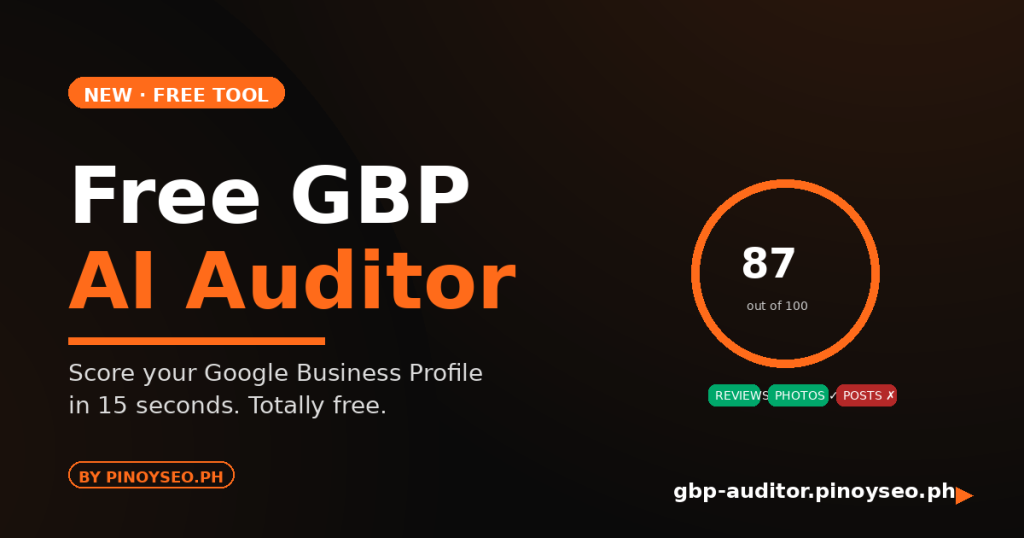
We have also built two free AI tools for SEOs and business owners. The GBP Auditor checks a Google Business Profile and shows what to fix to rank better in Google Maps. The ChatGPT Visibility tool checks whether ChatGPT mentions your brand when people ask about your industry. Both are free for now, and they may become freemium later, with the basic check staying free and deeper reports as a paid upgrade. Free tools are one of the easiest ways to earn links, traffic and trust, and those are exactly what an SEO knows how to turn into income.
Where should you start?
If you are new, do not try all twelve at once. This is the order I usually recommend:
Start with client SEO (way 1 or 2). It pays right away and teaches you what actually works. Our list of free SEO tools is a good starter kit.
Add services for the clients you already have (ways 3 and 4). It is easier to earn more from a happy client than to find a new one.
Build your own sites and products on the side (ways 5 to 9). They take longer, but they keep earning even when you are not doing client work.
Teach, refer and partner with brands (ways 10 to 12) once you have results and an audience people trust.
Earnings mentioned in this post are my own and are not a promise of what you will earn. Your results depend on your skills, effort and consistency.
Learn the skill that makes all of this possible
Every income stream in this post starts from the same place: knowing how to get a website found on Google and in AI search. That is exactly what we teach in the Pinoy SEO Bootcamp.
Batch 45 is now open, with only a few slots left. It starts on November 3, 2026, live on Zoom every Tuesday, Thursday and Saturday, 7:30–8:30 PM (PH time), for ₱4,500. See the Batch 45 details and reserve your slot. [...]
Read more...
September 19, 2026A new student testimonial just landed on the Pinoy SEO YouTube channel — and this one comes with a story we love telling.
Ralf Perino is a graduate of our Batch 33 SEO Training Bootcamp. After finishing that batch he did what every PinoySEO grad hopes to do: he went out, landed his first paying client, and started doing real SEO work — specifically Google Business Profile (GBP) optimization, one of the highest-ROI corners of local SEO today.
And now — a couple of batches later — he is back. Not for a repeat of the bootcamp, but enrolled in our 1-on-1 coaching program to sharpen the specific SEO skills his client accounts now demand.
From Batch 33 to a paying GBP client
Ralf’s original bootcamp — Batch 33 — walked him through the SEO fundamentals the same way every PinoySEO batch does: keyword research, on-page optimization, technical SEO, off-page basics, and the local SEO chapter that covers Google Business Profile in depth.
For a lot of new SEOs, GBP is where the first paid work shows up. There are two reasons for this. First, every brick-and-mortar business in the Philippines eventually needs it. Restaurants, clinics, salons, dental offices, real estate agents, driving schools, event venues — they all live and die by their Google Maps presence. Second, GBP is measurable in a way clients understand. You can show a screenshot of a listing at position 7 in the local pack today and position 2 next month. That before-and-after is easy to sell.
Ralf spotted that opportunity, positioned himself as a GBP specialist coming out of Batch 33, and landed a client. We are keeping that client’s details private, but the work is real, it is paid, and it is what most Bootcamp graduates are chasing in their first six months.
Why he came back for 1-on-1 coaching
Here is the part of the story that says the most about where Ralf is in his career: he did not go looking for a different course or a different coach. He came back to PinoySEO for a focused, 1-on-1 program — two things a group bootcamp can only partially deliver.
1. Focused education. A bootcamp is deliberately broad. It has to give twenty different students a shared foundation, so it moves through every SEO discipline at a general level. Once you are actively serving a client, though, your real questions are narrow and specific. “How do I fix this exact category of GBP suspension?” “Why is my client’s service-area listing losing to a competitor with fewer reviews?” “What is the fastest way to audit a WordPress site for technical issues before I quote a retainer?” Those questions do not have textbook answers. They need a real coach looking at your real account.
2. SEO checking of his client sites. This is the other half of what Ralf signed up for — someone senior reviewing the actual sites he is working on and telling him what he is missing. That kind of second-pair-of-eyes SEO auditing is worth more than a hundred YouTube tutorials once you are billing clients. You cannot Google your way to the specific fix your client needs. You need a coach with sixteen years in Philippine SEO to look at the audit with you and say “here is what I would prioritize, here is what I would ignore, and here is the argument you should use with the client.”
His portfolio site: perinorankslocal.com
There is a third piece of the 1-on-1 package worth showing off, and Ralf is a good example of it. Every 1-on-1 student gets a real, owned domain to use as a training and portfolio site — not a subdomain of pinoyseo.ph. Ralf’s is live at perinorankslocal.com.
To be clear: perinorankslocal.com is not his paying client. It is his own site, part of the 1-on-1 package he bought, and it is where he sharpens the techniques he then applies to real client accounts. Think of it like a med student’s teaching hospital — a controlled environment where a coach can watch you rank a page, fix a technical issue, or launch a local schema build without any client fires in the middle.
The reason we hand out a real domain instead of a subdomain is that it doubles as a portfolio asset. A real domain is transferrable, it is portfolio-grade for future job applications, and it is a serious signal to future clients that the student owns their work. Bootcamp students share a training subdomain because the training is broad; 1-on-1 students walk out with their own .com because the goal is to build a career, not just complete a course.
What this pattern tells us
The PinoySEO team notices this pattern with our strongest graduates: the ones who do best long-term treat their SEO career as a stack of investments, not a single course. Bootcamp gives the foundation. First client gives real reps. 1-on-1 coaching turns those reps into a specialization. Then that specialization compounds into a full agency, a senior in-house role, or an international consulting practice.
Ralf is on that trajectory. Batch 33 was his foundation. His current GBP client is his real-world lab. The 1-on-1 sessions are the accelerator. A year from now the story we expect to be telling about Ralf is not “he got his first client” — it is “he has a book of clients, a specialty, and a reputation.”
A quick word to current bootcamp students
If you are in the current batch or you have just graduated, look at Ralf’s timeline and take the useful pieces from it:
Pick a specialty early. Ralf picked GBP. It could be technical SEO, e-commerce SEO, WordPress SEO, or SaaS content SEO — but pick one lane where you can point at real work.
Charge before you feel ready. The first client you sign will teach you more than the last month of the bootcamp did. The paid pressure is the accelerator.
Get a senior review when the questions get specific. If your questions have moved from “what is a canonical tag” to “should I canonicalize these paginated category pages for this specific client,” that is the signal you have outgrown general lessons. Having an experienced SEO review your real work is what moves you forward from there.
To Ralf, from all of us
Thank you for sending the testimonial and — more importantly — for coming back. Watching a Batch 33 graduate re-invest in his own career is exactly the loop we built this program to create. Your GBP client is lucky to have you working on their account, and we are going to make sure your 1-on-1 sessions turn every question your client throws at you into a repeatable playbook.
Ikaw na, kabayan. See you in the next session.
Ready to start your own SEO career?
Ralf’s journey started in a Pinoy SEO Bootcamp batch. If you want the same foundation that got him from zero to a paying GBP client, the Pinoy SEO Bootcamp is where that starts.
Batch 44 is fully booked and starts on September 30, 2026. We will announce Batch 45 soon, so stay tuned to pinoyseo.ph and our newsletter so you don’t miss it.
If you are a bootcamp grad with an update to share, drop a comment below with your story. We would love to feature your win too. [...]
Read more...
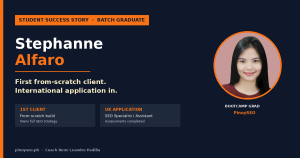
September 14, 2026Two milestones in one week. That is the update we just received from Stephanne Alfaro, one of our recent Pinoy SEO Bootcamp graduates.
The first: she just got her very first freelance SEO client. Not just any client — a from-scratch project where she’ll be building the entire SEO strategy from the ground up. No inherited setup. No existing team to lean on. Just her, the fundamentals she picked up from Bootcamp, and a real website that needs to grow.
The second: she has an active application in for an SEO Specialist / SEO Assistant role with a UK-based SEO specialist, working part-time. She has already completed the assessments and is now waiting for the results.
Two clients on the table. One local, from-scratch. One international, part-time. Both landed in the space of a single week.
Why a “from scratch” first client actually matters
A lot of new SEOs get their start by joining an established team — running keyword research for someone else’s strategy, updating meta descriptions inside someone else’s CMS, filing reports into someone else’s template. It is a fine way to start. You learn the tools quickly.
What you do not learn quickly that way is ownership. Deciding which keywords the site should chase. Deciding the site architecture. Deciding what stays in the sitemap and what gets no-indexed. Deciding when to publish, what to publish, and how to measure whether it worked.
Stephanne’s first client gives her all of that on day one. She owns the audit. She writes the strategy. She picks the tools. She sets the reporting cadence. She defends the calls. Six months into that kind of work, you have skills that a “junior SEO who did tasks” resume simply cannot show. You have case study material. You have before-and-after screenshots. You have a story to tell in interviews.
The PinoySEO team has watched this pattern play out with graduate after graduate: the ones who take a from-scratch client early — even a small one — accelerate past their peers within a year. Stephanne is starting on the fast track.
Applying internationally is not gatekept anymore
A few years ago, working for a UK SEO specialist meant either relocating or getting extraordinarily lucky with a remote-first agency. Today the game is different. UK, Australian, US, and Canadian SEO consultancies routinely hire part-time and fractional Filipino SEO specialists — because the SEO fundamentals are universal, English is the working language, and the time-zone overlap works for asynchronous project work.
Stephanne’s UK application is not an outlier. It is the direction the market is going. Foreign consultancies want SEO thinkers who can run a keyword project, deliver a technical audit, and communicate clearly in writing — three things every Pinoy SEO Bootcamp graduate is drilled on.
The assessments she is waiting on are usually a mix of: a keyword research task, a mock audit of a real client site, sometimes a written recommendation exercise. If Bootcamp did its job, none of these should be surprises. She has done exactly this kind of work in Batch training exercises already.
What this means for other graduates and current students
If you are in the middle of Bootcamp right now — or you just graduated and are wondering when the first client shows up — Stephanne’s timeline is a useful reference point.
Your first client rarely comes from a job board. It comes from a friend who owns a small business, a former colleague who runs a side hustle, a Facebook group where someone posts “hiring SEO.” The first “yes” is a conversation, not an application.
From-scratch work is the fastest teacher. If a friend needs help launching a site, take the project even if the scope is small. What you learn shipping a real launch is worth more than three months of hypothetical exercises.
Apply internationally in parallel. Do not wait until you feel “ready.” The application process itself is training. Assessments are how you find out where your gaps are, and every assessment you complete makes the next one easier.
Announce your availability publicly. Facebook post, LinkedIn banner, group intro. People need to know you are open for work before they can hire you.
The bigger picture
Stephanne is not the first graduate to land a first client within weeks of finishing Bootcamp. She will not be the last. But every update like hers reinforces what the PinoySEO team believes about Filipino SEO talent: the skill ceiling here is high, the market is real, and the international opportunities are already open. What was missing for a lot of aspiring SEOs was structured training that mapped one-to-one onto the work paying clients actually need. That is exactly what Bootcamp delivers.
The PinoySEO team is rooting for both applications — local and international — to convert. Stephanne, from all of us: ikaw na, kabayan. We know you have the foundations. Now it is just about executing what you already know.
Want to write your own success update?
If you are ready to start your SEO career — with a curriculum built around real client work, not textbook theory — the Pinoy SEO Bootcamp is where our graduates like Stephanne got their foundation. Batch 44 is open now. Check the homepage for the current schedule and enrollment details.
And if you are a Bootcamp graduate with a story like Stephanne’s — a first client, a job offer, a milestone — send it to us. We would love to feature your win too. [...]
Read more...
-

SEO & AEO Specialist
Kairos RecruitmentPhilippines (Remote) -

Senior SEO Specialist
MedVirtualPhilippines (Remote) -

Content SEO Specialist
EastvantageMandaluyong, National Capital Region, Philippines -

SEO & GEO Executive
R50 Website Design and MarketingUK (Remote) -

SEO Executive
DigitalNeuralsPhilippines (Remote)