
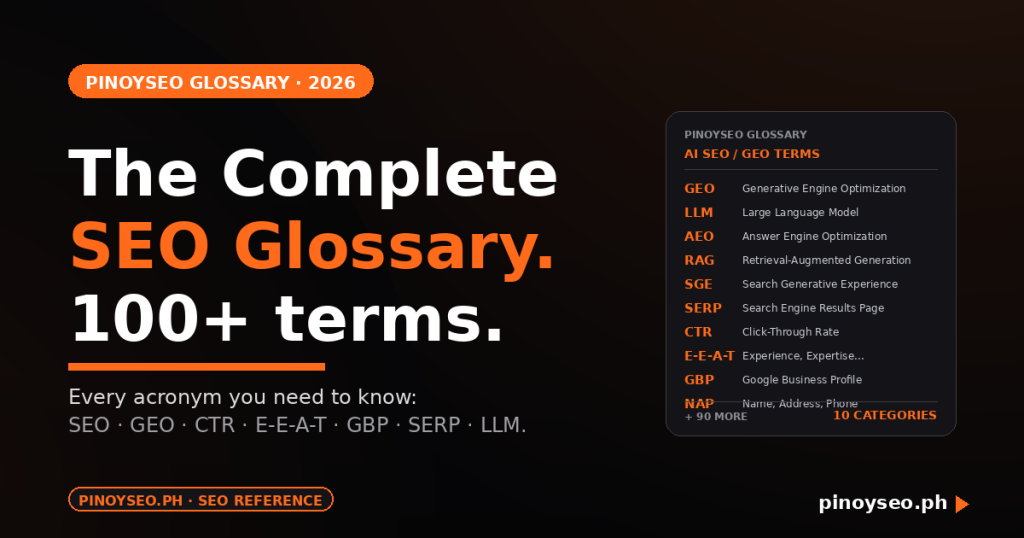
SEO is riddled with acronyms — some obvious, some intimidating, and a growing number of brand-new ones from the AI era. If you’ve ever sat in a strategy call and heard someone say “we need to improve E-E-A-T for GEO before the next SGE update” and quietly nodded, this glossary is for you.
Below are 100+ SEO terms and acronyms every Filipino SEO specialist, freelancer, agency owner, and business owner should understand in 2026 — organized by category, with a short plain-English definition for each. Bookmark this page, share it with your team, and use it as a reference in bootcamp discussions.
1. Core SEO Fundamentals
- SEO — Search Engine Optimization. The practice of improving a website’s visibility in unpaid (organic) search results.
- SEM — Search Engine Marketing. The umbrella term covering both SEO and paid search advertising (like Google Ads).
- SERP — Search Engine Results Page. The page Google (or Bing) shows you after a query.
- Ranking — Where your page appears in the SERP for a specific query (e.g., “position 3 for ‘seo training philippines'”).
- Indexing — The process of Google adding your page to its searchable database. If you’re not indexed, you don’t exist to Google.
- Crawling — When a search engine bot (like Googlebot) visits your site to discover new or updated content.
- White Hat SEO — SEO techniques that follow Google’s guidelines. Long-term, safe.
- Black Hat SEO — Manipulative techniques that violate Google’s guidelines (buying links, keyword stuffing, cloaking). Short-term wins, long-term penalties.
- Gray Hat SEO — Techniques that live in the gray area between white and black hat. Not banned yet but risky.
- Algorithm — The formula Google uses to rank pages. Continuously updated.
- Algorithm Update — A change to Google’s ranking formula (e.g., Core Update, Helpful Content Update, Spam Update).
- Google Dance — Old term for rankings fluctuating during an algorithm update.
2. Search Engines, Crawling & Indexing
- Googlebot — Google’s crawler. Has desktop and mobile versions.
- Bingbot — Bing’s crawler. Important because ChatGPT uses Bing for web search.
- Crawl Budget — The number of URLs Googlebot will crawl on your site within a given timeframe.
- Crawl Rate — How fast Googlebot fetches pages from your site.
- Crawl Depth — How many clicks from the homepage a page is buried under.
- Robots.txt — A text file at yoursite.com/robots.txt that tells crawlers which URLs they can or cannot access.
- Sitemap (XML) — A file that lists all the URLs on your site to help search engines discover them faster.
- noindex — A meta tag or HTTP header that tells search engines “don’t include this page in your index.”
- nofollow — A link attribute that tells search engines “don’t pass authority through this link.”
- Rendered HTML — The final HTML the browser produces after JavaScript executes. Different from the raw HTML on many modern sites.
3. On-Page SEO
- Title Tag — The clickable headline shown on the SERP. Should be under ~60 characters.
- Meta Description — The snippet under the title on the SERP. Should be under ~155 characters.
- H1, H2, H3 — HTML heading tags. One H1 per page (the main topic); H2s for major sections; H3s for subsections.
- Slug / URL Slug — The final part of the URL (e.g.,
/seo-training-philippines). - Anchor Text — The clickable text of a hyperlink.
- Alt Text — Alternative text for images. Helps accessibility and image SEO.
- Canonical Tag — Tells Google “this URL is the master version” when duplicate or similar pages exist.
- Meta Robots — A meta tag that controls indexing behavior (
<meta name="robots" content="noindex">). - Open Graph (OG) Tags — Meta tags that control how your page appears when shared on Facebook, LinkedIn, etc.
- Twitter Cards — Similar to OG tags but for X (Twitter) previews.
- Schema Markup — Structured data (in JSON-LD, microdata, or RDFa format) that tells search engines what your page is about (a recipe, product, article, business, etc.).
- Breadcrumb — Navigational trail (Home > Blog > Post) that also helps SEO when marked up with schema.
- Featured Image — The main image associated with a post; often used in social sharing previews and blog grids.
- Content Freshness — How recently a page was updated. Fresh content tends to rank better for news and trending topics.
4. Technical SEO
- SSL / HTTPS — Secure Sockets Layer. HTTPS is HTTP over SSL. Google ranks HTTPS sites higher.
- Core Web Vitals (CWV) — Google’s page-experience metrics: LCP, INP, and CLS.
- LCP — Largest Contentful Paint. How fast the biggest visible element loads. Target: under 2.5 seconds.
- INP — Interaction to Next Paint. How responsive your page feels to clicks/taps. Target: under 200ms. (Replaced FID in 2024.)
- FID — First Input Delay. Old responsiveness metric, replaced by INP.
- CLS — Cumulative Layout Shift. How much elements jump around while loading. Target: under 0.1.
- TTFB — Time To First Byte. How long the server takes to start responding. Under 800ms is good.
- Mobile-First Indexing — Google uses your mobile version as the primary version for ranking.
- AMP — Accelerated Mobile Pages. Google’s fast-loading page format, largely deprecated for organic ranking benefit.
- 301 Redirect — Permanent redirect. Passes SEO value to the destination URL.
- 302 Redirect — Temporary redirect. Does not fully pass SEO value.
- Hreflang — Tag that tells Google which language and region a page is for (essential for multi-country sites).
- Structured Data — Umbrella term for schema markup that helps Google understand your content in a machine-readable way.
5. Off-Page SEO & Backlinks
- Backlink — A link from another website pointing to yours. Still one of Google’s top ranking factors.
- Do-Follow Link — A backlink that passes SEO authority.
- No-Follow Link — A backlink with
rel="nofollow"that doesn’t pass authority (but still valuable for referral traffic and diversity). - UGC Link — User-Generated Content link (blog comments, forum posts). Tagged
rel="ugc". - Sponsored Link — Paid or affiliate link. Tagged
rel="sponsored". - DA — Domain Authority (Moz metric, 0–100). Predicts how well a domain ranks.
- DR — Domain Rating (Ahrefs metric, 0–100). Similar to DA but Ahrefs’ version.
- UR — URL Rating (Ahrefs metric). Same concept but for a single page.
- Link Juice / Link Equity — Informal term for the SEO value passed through a backlink.
- PBN — Private Blog Network. A network of sites built solely to link to your money site. High-risk black hat tactic.
6. Keywords & Content
- Long-Tail Keyword — A specific, multi-word search phrase with lower volume but higher intent (e.g., “hire filipino seo specialist for shopify”).
- Short-Tail / Head Keyword — Broad, high-volume search term (e.g., “SEO”).
- Search Intent — Why the user is searching: informational, navigational, commercial, or transactional.
- KGR — Keyword Golden Ratio. A formula to identify low-competition keywords worth targeting.
- LSI — Latent Semantic Indexing. Related terms Google associates with your topic. (Note: Google says pure “LSI” isn’t real, but the concept of semantic relevance still matters.)
- TF-IDF — Term Frequency – Inverse Document Frequency. A statistical measure of how important a word is in a document relative to a corpus.
- E-E-A-T — Experience, Expertise, Authoritativeness, Trustworthiness. Google’s quality-rater guidelines framework. (Added “Experience” in 2022.)
- YMYL — Your Money or Your Life. Pages that affect health, finances, safety — Google holds them to a higher E-E-A-T standard.
- Content Silo — A structure of tightly-related content around a topic to build topical authority.
- Topic Cluster — A pillar page + supporting posts. Modern replacement for content silos.
- Pillar Page — The main, comprehensive page for a topic that links out to related supporting posts.
7. Analytics, Metrics & KPIs
- KPI — Key Performance Indicator.
- CTR — Click-Through Rate. Clicks ÷ impressions × 100.
- Bounce Rate — % of visitors who leave without a second pageview. (GA4 uses “engagement rate” now instead.)
- Engagement Rate — GA4’s replacement for bounce rate. % of engaged sessions (10+ seconds, 2+ pages, or a conversion).
- Impressions — How many times your page appeared in the SERP.
- CPC — Cost Per Click. Common in Google Ads.
- CPM — Cost Per Mille (thousand impressions).
- CPA — Cost Per Acquisition. How much it costs to acquire one customer.
- ROI — Return On Investment.
- ROAS — Return On Ad Spend.
- Conversion Rate — % of visitors who complete a desired action (buy, sign up, book).
- Session — A group of user interactions with your site within a time window (default 30 min in GA4).
- UTM — Urchin Tracking Module. URL parameters (
?utm_source=...) that tell Google Analytics where traffic came from.
8. AI SEO / GEO (The Newest Category)
- GEO — Generative Engine Optimization. Optimizing to be cited by AI answer engines (ChatGPT, Perplexity, Google AI Overviews, Gemini). The new “SEO for the AI era.”
- AEO — Answer Engine Optimization. Similar concept to GEO — optimizing to be the answer AI engines cite.
- LLM — Large Language Model. The underlying tech powering ChatGPT, Claude, Gemini, etc.
- llms.txt — Emerging standard: a text file at yoursite.com/llms.txt that tells LLMs which pages matter most and what your business does.
- RAG — Retrieval-Augmented Generation. When an LLM fetches live web content (via a search engine like Bing) before generating an answer.
- SGE — Search Generative Experience (Google’s early name for AI Overviews).
- AI Overviews — Google’s AI-generated answer box that appears above the traditional 10 blue links.
- Mention Rate — % of prompts where your brand is named in an LLM’s answer.
- Share of Voice (AI) — Your brand’s share of total brand mentions across a set of prompts.
- Entity SEO — Optimizing your brand as a recognizable entity (via schema, consistent NAP, Wikipedia/Wikidata presence) so LLMs and Google understand who you are.
- Prompt Visibility — Whether your brand appears when a user asks a specific buyer-intent prompt.
- AI Citation — When an AI engine names your brand or links to your site in a response.
Not sure if ChatGPT recommends your brand? Try our free ChatGPT Visibility Checker — it takes 30 seconds.
9. Local SEO
- GBP — Google Business Profile (formerly Google My Business).
- GMB — Google My Business (old name for GBP). Still heard in the wild.
- NAP — Name, Address, Phone. Must be consistent across your site and all citations.
- Citations — Mentions of your business’s NAP on other websites (Yelp, directories, chambers of commerce).
- Map Pack / Local Pack — The 3 local business listings that appear above organic results for local queries.
- Local Finder — The expanded local listings page (after clicking “More places” in the Map Pack).
- Service-Area Business — A business that serves customers at their location (plumbers, cleaners). Uses service areas instead of a physical address on GBP.
- Geotargeting — Optimizing content or ads for a specific geographic area.
- Review Snippets — Star ratings shown in the SERP via review schema.
- Local Citation Building — The process of getting your business listed on relevant local directories.
Audit your GBP for free with our GBP Auditor tool — 0–100 score in 15 seconds.
10. Tools & Platforms Every SEO Should Know
- GSC — Google Search Console. Free tool showing how your site performs in Google Search (queries, clicks, impressions, indexing issues). Now also tracks Instagram, TikTok, X, YouTube properties.
- GA4 — Google Analytics 4. The current version of Google Analytics.
- GTM — Google Tag Manager. Adds tracking tags without editing code.
- Ahrefs — Popular SEO platform (backlinks, keywords, site audit).
- Semrush — Ahrefs competitor with similar features.
- Moz — SEO platform known for DA and Link Explorer.
- Screaming Frog — Desktop technical SEO crawler.
- Yoast SEO — Popular WordPress SEO plugin.
- Rank Math — Alternative WordPress SEO plugin.
- PageSpeed Insights (PSI) — Google’s free page-speed testing tool.
For our full list of recommended SEO tools by category, see our Ultimate List of SEO Tools in 2026.
Bonus: Terms You’ll Hear on Filipino SEO Calls
- Ranking Signal — Any factor Google uses to rank pages (there are 200+, though only a few dozen carry real weight).
- Manual Action — A penalty applied by a human Google reviewer (as opposed to an algorithmic drop).
- Sandbox — The informal name for the period where a brand-new site struggles to rank.
- Cannibalization — When two of your own pages compete for the same keyword.
- Content Decay — When a piece of content that used to rank starts losing traffic over time.
- Zero-Click Search — Searches where the user gets their answer directly on the SERP (via Featured Snippet, AI Overview, Knowledge Panel) without clicking any result.
- Featured Snippet — The answer box that appears at the top of the SERP with a direct answer pulled from a page.
- People Also Ask (PAA) — The expandable question box in Google’s SERP.
- Knowledge Panel — The information card that appears on the right of the SERP for known entities.
- Dwell Time — How long a visitor stays on your page after clicking from Google.
Want to actually use these — not just read them?
Every one of these terms comes up in real client work, real client calls, and real bootcamp sessions. Reading them here is step one. Applying them to a live client’s site is where the real skill develops.
If you want to build fluency the fastest way, that’s what we teach in the 4-Week SEO + GEO Bootcamp — every term above gets used in context on a real ranking project. If you already know the terms and want strategy help on a specific site or campaign, book a free strategy call with our team.
Bookmark this page. Send it to a client. Share it with your team. And if there’s an acronym you keep hearing that isn’t on this list — DM me on Facebook and I’ll add it to the next update.
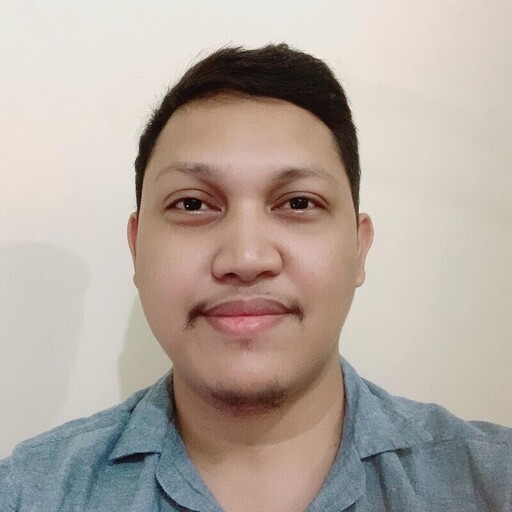
Coach Leandro is an award-winning SEO specialist in the Philippines with over 16 years of professional experience as an SEO consultant. He has successfully managed clients from the US, Australia, UK, and Canada, delivering data-driven strategies that generate measurable results in search engine visibility and business growth.
In 2024, he was recognized as the “Outstanding Digital Freelancer of the Year” by the City Government of Iligan for his significant contributions to the freelancing and digital marketing industry.
He is the Founder and Owner of SOVA.ph, PinoySEO.ph, and MalachiSoft.com, where he continues to lead projects, mentor aspiring professionals, and provide SEO training programs tailored to the global market.
As a trusted SEO consultant and business owner in the Philippines, Coach Leandro is dedicated to helping businesses and individuals achieve long-term online success.
Beyond his professional achievements, Coach Leandro is also a passionate drone pilot, enjoying aerial photography and creative storytelling through drone videography.