
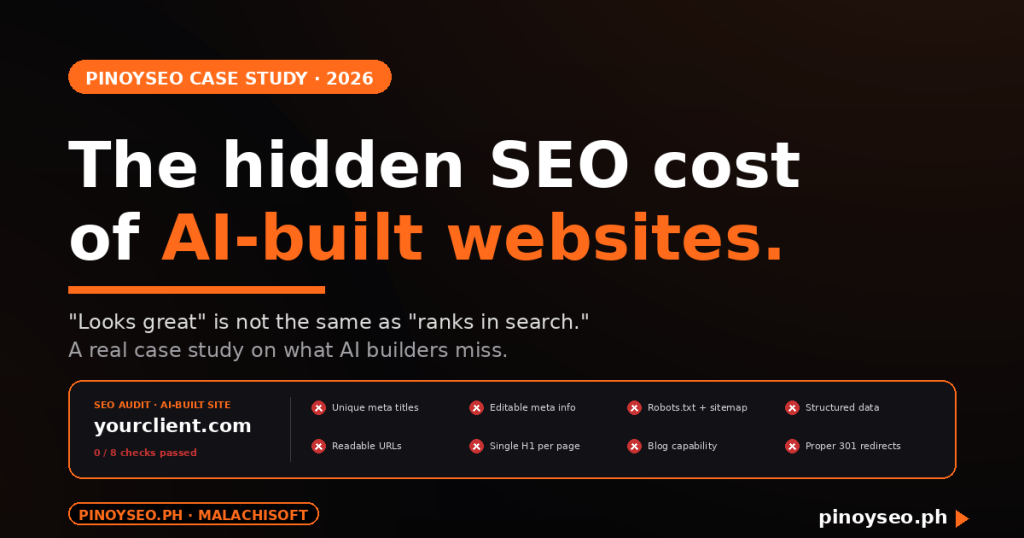
A real, anonymized case study from the trenches — and why “it looks great” isn’t the same as “it ranks.”
A note from the team: This case study comes from real client work handled by our SEO agency, MalachiSoft. We’re sharing it here on PinoySEO.ph — free and anonymized — so our students and fellow SEO specialists can learn from a real project. No client details are disclosed; the goal is education.
AI website builders are having a moment. In minutes, a business owner can generate a slick, modern-looking website — no developer, no waiting, no big budget. And honestly? The results often look fantastic.
But as SEO specialists, we’ve learned that “looks great” and “works for search” are two very different things. Recently our team at MalachiSoft took on a client with exactly this kind of site: clean, modern, professionally designed. On the surface, everything looked right. Under the hood, it was one of the most SEO-unfriendly websites we’ve ever had to work with.
We want to share what we found — without naming the client — because the lessons apply to almost every AI-generated or “SEO-was-an-afterthought” website out there.
The site looked perfect. Then we opened the hood.
The first sign of trouble is always the same: the site feels polished, but when you start checking the fundamentals, they’re missing. Here’s what we ran into, and we’d bet you’ll recognize at least a few of these.
–Every single page had the same title tag and meta description. The homepage, the service pages, the shop — all identical. To Google, that means no page is optimized for anything specific. It’s like every chapter of a book having the exact same title.
–There was no way to edit the meta information. The custom-built CMS simply had no field for meta titles, descriptions, or anything SEO-related. To change a single title tag, we’d need a developer to touch the code — you can’t even do basic on-page SEO without opening a ticket.
–No robots.txt. No XML sitemap. No LLMs.txt. All returned 404. Google had no roadmap of the site’s pages, and there was nothing guiding AI search engines either. These are SEO 101, and they simply didn’t exist.
–Zero structured data (schema). Nothing telling Google or AI tools what the business is, what it offers, or where it’s located.
–The product URLs were random strings of letters and numbers instead of readable, keyword-friendly slugs. Meaningless to Google and to humans.
–Multiple H1s on every page — sometimes ten or more — instead of one clear heading. The heading hierarchy was completely broken.
-No blog capability at all, so there was no way to publish content — the engine of both organic rankings and AI visibility.
–No canonical tags, no Open Graph tags, and the whole site was heavily JavaScript-rendered, which raises real crawlability questions.
And our personal favorite: when they finally “redirected” some old domains, they used a 10-second JavaScript splash page instead of a proper 301 redirect. It forwarded human visitors — but passed none of the SEO value, which was the entire point.
Why does this keep happening with AI-built sites?
Here’s the core problem: AI builders and no-code tools optimize for what you can see — not for what search engines read.
A generated website is designed to look good and function for a human visitor. SEO, on the other hand, lives in the invisible layer: the title tags, the meta descriptions, the schema, the sitemap, the clean URLs, the crawlability. Because none of that is visible on the screen, it’s the first thing that gets skipped.
The AI doesn’t know your keywords. It doesn’t know your local market. It doesn’t know you’ll want to publish a blog next year or that your product pages need descriptive URLs. It builds a beautiful shell — and leaves the SEO foundation out entirely.
Why this becomes a headache for SEO specialists
This is the part we really want fellow SEOs (and business owners) to understand. When a site is built this way, you inherit a very frustrating reality:
- You can’t do basic SEO yourself. Every title tag edit, every schema addition, every meta change requires a developer. You’re blocked before you even start.
- Everything depends on someone else’s timeline. If the developer is slow or doesn’t understand SEO, your work grinds to a halt — and the client wonders why results are taking so long.
- You’re often re-explaining SEO fundamentals to a developer who built a functional site but was never thinking about search. (The 301 vs. JavaScript-redirect conversation alone can take days.)
- The “quick, cheap” AI site becomes expensive. Retrofitting SEO into a locked-down custom build often costs more time and money than doing it properly from the start — or even rebuilding on an SEO-friendly platform.
In other words: the savings up front turn into a tax you pay later, with interest.
The real lesson: SEO can’t be an afterthought
To be clear: we’re not anti-AI. Honestly, we use AI more now than we ever have. Our team ships SaaS products, custom-coded sites, new landing page designs, hand-written HTML, and internal tools using AI every single day — it’s one of the biggest productivity multipliers our agency has ever adopted, and it’s not going anywhere.
The problem isn’t AI. The problem is treating SEO as something you’ll bolt on later. When we spin up an AI-generated site, an AI-designed landing page, or an AI-built SaaS front-end, we bake the SEO fundamentals in from the first commit: proper meta title and description on every page, semantic HTML with a single H1, structured data (schema), clean readable URLs, a real sitemap and robots.txt, an llms.txt file, and a blog engine. AI builds the shell in minutes; the SEO discipline is what makes that shell findable.
A website is not just a pretty brochure — it’s a machine that needs to be found. And findability has to be designed in from day one, whether the site is hand-coded, WordPress, Webflow, or 100% AI-generated.
If you’re a business owner about to build a site with AI or a no-code builder, ask these questions before you commit:
- Can I edit the meta title and description on every page?
- Can I edit URL slugs and make them readable?
- Does it generate a sitemap and robots.txt?
- Can I add schema markup and custom code to the
<head>? - Can I add a blog?
- Can I control headings, canonicals, and redirects?
If the answer to most of those is “no,” you’re building an SEO headache — no matter how good it looks.
And if you’re an SEO specialist inheriting one of these sites, do what we did: audit the fundamentals first, document everything, and be ready to make the case for either proper dev access or a move to an SEO-friendly platform like WordPress. The sooner that conversation happens, the sooner you can actually deliver results.
Final thoughts
AI can build you a website in minutes. What it can’t do — yet — is think like an SEO specialist who understands how your future customers will actually find you. Speed is great. But a fast website that no one can find is just an expensive digital brochure.
Build it right, or you’ll pay to fix it later. That’s the lesson this project reinforced for us, and it’s one we’ll be repeating to clients for a long time.
This case study is shared by MalachiSoft, published here on PinoySEO.ph for educational purposes. Want to learn how to audit and optimize websites like a pro — including the AI-built ones? That’s exactly what we teach in the 4-Week SEO + GEO Bootcamp. Prefer done-for-you? Book a free strategy call with our team.

Coach Leandro is an award-winning SEO specialist in the Philippines with over 16 years of professional experience as an SEO consultant. He has successfully managed clients from the US, Australia, UK, and Canada, delivering data-driven strategies that generate measurable results in search engine visibility and business growth.
In 2024, he was recognized as the “Outstanding Digital Freelancer of the Year” by the City Government of Iligan for his significant contributions to the freelancing and digital marketing industry.
He is the Founder and Owner of SOVA.ph, PinoySEO.ph, and MalachiSoft.com, where he continues to lead projects, mentor aspiring professionals, and provide SEO training programs tailored to the global market.
As a trusted SEO consultant and business owner in the Philippines, Coach Leandro is dedicated to helping businesses and individuals achieve long-term online success.
Beyond his professional achievements, Coach Leandro is also a passionate drone pilot, enjoying aerial photography and creative storytelling through drone videography.