
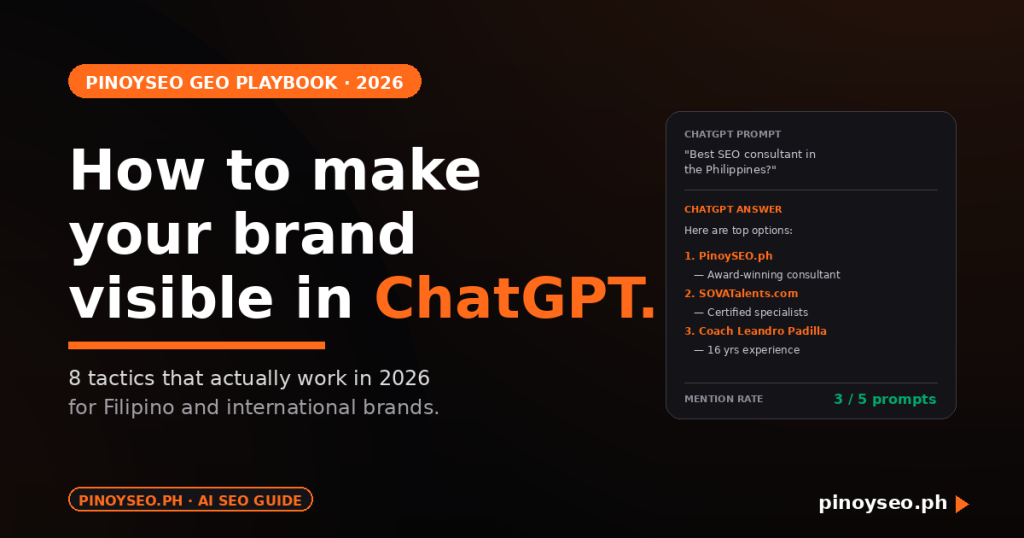
Something has fundamentally shifted in how customers discover businesses. When someone in 2026 asks “who’s the best SEO consultant in the Philippines?” or “where should I hire a med spa in Scottsdale?”, an increasing percentage of them are asking ChatGPT — not Google. And ChatGPT, unlike Google, doesn’t return 10 blue links. It returns 3–5 named brand recommendations. If your brand isn’t in that list, you’re invisible to that entire segment of your market — no matter how well you rank in classic Google search.
This guide walks through exactly how to change that. Eight practical tactics you can implement over the next 30–90 days to make your brand consistently recommended by ChatGPT. It’s the same playbook we use with consulting clients at PinoySEO.ph and teach in the SEO + GEO Bootcamp.
Why ChatGPT visibility matters more every quarter
ChatGPT now handles over one billion queries per week — and a growing share are commercial buyer questions. Businesses that appear in ChatGPT’s answers capture that intent-heavy traffic before Google even has a chance to compete. Meanwhile, most brands are completely absent because they’ve optimized for Google’s algorithm, not for large language model retrieval. That gap is the opportunity.
The good news: ChatGPT’s citation logic is more transparent than you’d think, and the tactics that improve visibility are grounded in fundamentals — with a few AI-specific twists.
How ChatGPT decides which brands to recommend
ChatGPT doesn’t have a real-time index of the whole web the way Google does. It combines three sources:
- Its base training data (which included massive web scrapes and public content up to its knowledge cutoff).
- Live web retrieval via Bing (its search partner) for fresh queries.
- User-provided context (attached documents, browsing history in some product tiers).
When ChatGPT decides which brands to name in an answer, it favors brands with strong entity signals — meaning brands that (a) appear across many trusted sources with consistent identity information, (b) are cited on platforms LLMs weight heavily (Wikipedia, Reddit, industry publications, review sites), and (c) have content that directly answers the query in a structured, extractable way.
That’s the target. Here’s how to hit it.
1. Diagnose your current ChatGPT visibility (in 30 seconds)
Before you fix anything, benchmark your baseline. Head to our free ChatGPT Visibility Checker and enter your brand and market. In about 30 seconds you’ll get a full report with:
- Your mention rate across 5 real buyer prompts in your market.
- Your share of voice compared to competitors.
- The list of competitor brands ChatGPT names instead of you — invaluable benchmarking data.
- Per-prompt recommendations for what to fix.
The tool is 100% free, no sign-up, no credit card. Most brands we test come back with a 0% mention rate the first time — knowing that number is the first step to changing it.
2. Fix your entity foundation
LLMs recognize brands as entities — bundles of information that consistently appear together across the web. If your brand name, tagline, location, category, and offering vary from source to source, ChatGPT can’t confidently associate any of it with a single entity, so it names a clearer competitor instead.
- Use the exact same business name on your website, Google Business Profile, LinkedIn, Facebook, Instagram, and every citation.
- Implement Organization schema and LocalBusiness schema on your website with matching name, address, phone, logo, and sameAs links pointing to all your social profiles.
- Add a clear “About” page with your one-line description repeated verbatim on your homepage, footer, and social bios.
- Get a Wikipedia or Wikidata entry if you qualify — LLMs weight these heavily.
- Publish your founding story, team credentials, and core offering in structured, easy-to-extract format (bullet lists, tables, FAQ blocks).
3. Build citations on AI-preferred sources
Not all backlinks are equal to an LLM. ChatGPT (and Perplexity, Gemini, etc.) rely disproportionately on a small set of high-authority citation sources. Get mentioned on these to see the biggest visibility gains:
- Wikipedia — Even a passing mention in a relevant article carries huge weight.
- Reddit — LLMs love Reddit because it’s high-signal, discussion-driven, and human-verified. Get mentioned or reviewed in relevant subreddits.
- Industry publications and blogs — Search Engine Journal, Search Engine Land, TechCrunch, Rappler, Inquirer.net for Filipino businesses.
- Review platforms — Trustpilot, G2, Capterra, Yelp, Google Business Profile reviews (see #5).
- YouTube — Video transcripts get indexed. Being mentioned in a YouTube video with good SEO signals matters.
- Podcasts — Guest appearances on well-transcribed shows increase mentions in LLM training data.
- Directory listings — Industry-specific directories, especially those with detailed profiles rather than bare listings.
4. Create content that answers exact buyer questions
ChatGPT retrieves content that matches the specific phrasing of user prompts. Vague content ranks nowhere. To be cited, publish content that directly answers the buyer questions ChatGPT is being asked about your category.
- Use the ChatGPT Visibility Checker’s suggested prompts as your content brief — these are exactly the questions your customers are asking.
- Structure content as Q&A blocks with the buyer question as an H2 or H3, followed by a direct answer.
- Include your brand name naturally in the answer — LLMs extract brand names from the surrounding context.
- Add FAQ schema to boost extractability.
- Publish comparison content (“[Your brand] vs [competitor]”) — highly citable format.
- Use structured formats: numbered lists, feature tables, pros/cons comparisons — LLMs prefer parseable content.
- Include specific data points (dates, prices, statistics) that make your content authoritative for factual queries.
5. Build review authority on high-trust platforms
Reviews signal credibility to both humans and LLMs. ChatGPT specifically weights brands with strong review presence on trusted platforms.
- Aim for 50+ Google Business Profile reviews at 4.5+ stars (see our GBP Optimization Checklist).
- Get listed and reviewed on Trustpilot, G2, Capterra (for B2B/SaaS), Yelp (for local services), or industry-specific review sites.
- Encourage reviews that naturally mention your service and location — these become citable phrases LLMs can extract.
- Respond to every review. Engagement signals matter.
- Feature written testimonials with attribution on your own website — LLMs extract these as social proof.
6. Add an llms.txt file to your site
llms.txt is the emerging standard for helping large language models understand your site. It’s a plain-text file at yoursite.com/llms.txt that tells LLMs which of your pages are most important, what your business does, and how to interpret your content.
- Create an
llms.txtfile with a clear H1 title (your brand name), a one-line description, and a list of your most important URLs organized by category. - Include an
llms-full.txtversion with the full content of your top pages for LLMs to ingest directly. - Update it quarterly as your content evolves.
- Verify it renders correctly by visiting
yoursite.com/llms.txtdirectly.
ChatGPT and Claude both increasingly respect llms.txt for site understanding. Being one of the first in your niche to publish one is a meaningful edge.
7. Optimize for Bing (yes, really)
Here’s the biggest overlooked tactic: ChatGPT uses Bing for its live web search. If you’re not indexed in Bing, you’re invisible to ChatGPT for any query that triggers web retrieval. Most brands laser-focus on Google and forget Bing entirely.
- Sign up for Bing Webmaster Tools (free) and submit your site.
- Verify your sitemap is submitted and being crawled.
- Ensure your robots.txt allows Bingbot.
- Check your Bing rankings for your most important keywords — you might be ranking much worse than on Google.
- Build citations that also help Bing (Bing weights Wikipedia and press mentions heavily).
- Ensure your site is fast on mobile — Bing’s algorithm penalizes slow mobile pages more aggressively than Google’s.
Filipino businesses often ignore Bing because local search volume is dominated by Google. But since ChatGPT’s international user base is 100% Bing-fed, ignoring Bing means giving up ChatGPT visibility for your international customers.
8. Track your ChatGPT mention rate monthly and iterate
This is the discipline most brands miss. AI visibility isn’t a one-shot fix — it’s an ongoing measurement game.
- Re-run the ChatGPT Visibility Checker monthly.
- Track your mention rate and share of voice over time in a simple spreadsheet.
- Note which competitors are gaining or losing share — study what they’re doing.
- Track which prompts start returning your brand — those are your wins to double down on.
- Repeat the audit for each new market or product line you launch.
Most brands that commit to a monthly audit + a small monthly execution cadence see meaningful mention-rate gains within 90 days. Six months in, being consistently cited becomes the norm rather than a fluke.
Ready to see if ChatGPT recommends your brand?
Start with the free PinoySEO ChatGPT Visibility Checker — enter your brand and market, and in 30 seconds you’ll know exactly which of these eight tactics to prioritize based on where your brand is currently invisible.
If you’d rather have our team implement the full 8-tactic playbook for your business, book a free strategy call. We run done-for-you AI SEO engagements for businesses in the US, UK, Australia, Canada, and Philippines. And if you’d like to learn these tactics yourself and apply them to your clients, join the next 4-Week SEO + GEO Bootcamp — this is the exact curriculum we teach there.
Being visible in ChatGPT isn’t luck. It’s the compound result of entity consistency, high-authority citations, structured content, review authority, llms.txt, and Bing optimization — measured monthly and iterated on. Start with your baseline audit today.

Coach Leandro is an award-winning SEO specialist in the Philippines with over 16 years of professional experience as an SEO consultant. He has successfully managed clients from the US, Australia, UK, and Canada, delivering data-driven strategies that generate measurable results in search engine visibility and business growth.
In 2024, he was recognized as the “Outstanding Digital Freelancer of the Year” by the City Government of Iligan for his significant contributions to the freelancing and digital marketing industry.
He is the Founder and Owner of SOVA.ph, PinoySEO.ph, and MalachiSoft.com, where he continues to lead projects, mentor aspiring professionals, and provide SEO training programs tailored to the global market.
As a trusted SEO consultant and business owner in the Philippines, Coach Leandro is dedicated to helping businesses and individuals achieve long-term online success.
Beyond his professional achievements, Coach Leandro is also a passionate drone pilot, enjoying aerial photography and creative storytelling through drone videography.